

Dima Fayyad (Electrical & Computer Engineering), Sean Holt (Math), David Rein (Computer Science/Math) spent ten weeks exploring tools that will operationalize the application of distributed computing methodologies in the analysis of electronic medical records (EMR) at Duke. As a case study, they applied these systems to an Natural Language Processing project on clinical narratives about...
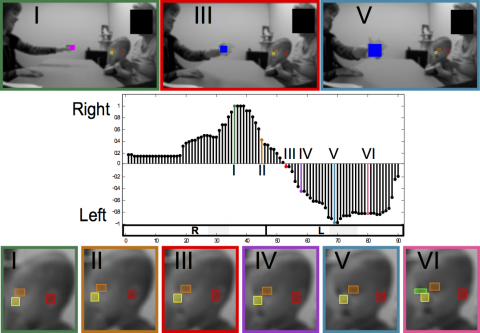
Imagine a world where we understand how to detect mental health and developmental problems in early childhood so that we can intervene early in life and prevent future suffering and impairment. This is a challenge that can only be addressed by an interdisciplinary team of computational people with child psychiatrists...

A team of students led by researchers from the Nicholas School of the Environment developed an app to estimate the distance of animals from a camera trap. Students merged camera trap data with terrestrial lidar (3D imagery of forest around the camera trap) to locate the position of animals. By...
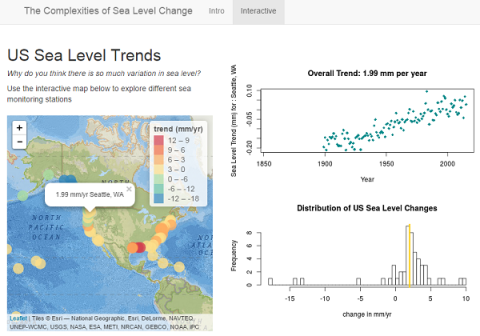
Molly Rosenstein, an Earth and Ocean Sciences major and Tess Harper, an Environmental Science and Spanish major spent ten weeks developing interactive data applications for use in Environmental Science 101, taught by Rebecca Vidra. Project Results The team created 6 applications, including ones on climate change and mountaintop mining, and tested them out on the entire...
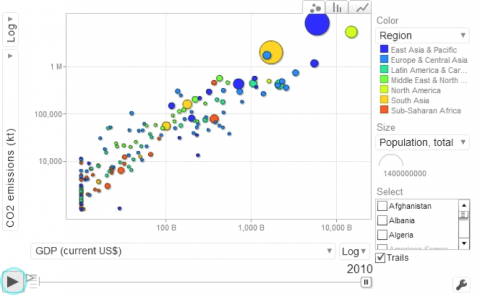
Graduate students: Aaron Berdanier and Matt Kwit, University Program in Ecology & Nicholas School of the Environment Faculty instructors: Rebecca Vidra Course: ENVIRON 102, Fall 2014

Graduate Students: Kendra Kaiser and John Mallard Faculty: Michael O’Driscoll Course: Landscape Hydrology, EOS 323/723 The goals of this exercise were twofold: introduce students to scientific programming languages and reinforce hydrological concepts through an assignment that utilized a publically available high-frequency dataset. Although analysis of environmental data is almost always...
Students on this project will assist Illumina with the research and assessment of Community-Based Review Boards to enable greater transparency in the ethical collection and use of patient data. Students should expect to familiarize themselves with the context of different types of ethics review boards and their role in the...

Aaron Chai (Computer Sciece, Math) and Victoria Worsham (Economics, Math) spent ten weeks building tools to understand characteristics of successful oil and gas licenses in the North Sea. The team used data-scraping, merging, and OCR method to create a dataset containing license information and work obligations, and they also produced ArcGIS visualizations of...
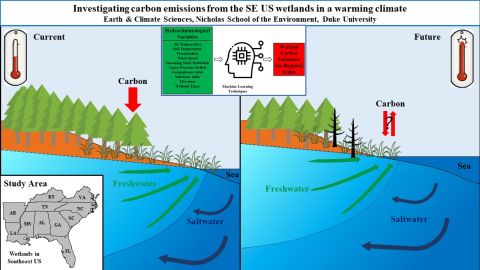
This project is also part of Duke’s first Climate+ cohort. A team of students led by researchers in the Hydroclimatological Lab will comprehensively quantify the wetland carbon emissions in the entire Southeast (SE) US using machine learning techniques and various climate datasets—including in situ measurements, remote sensing data, climate observations,...

The students in this project worked on a pervasive question in literary, film, and copyright studies: how do we know when a new work of fiction borrows from an older one? Many times, works are appropriated, rather than straightforwardly adapted, which makes it difficult for human readers to trace. As...

Students will collaborate to develop a document that outlines the current policy, research, and practice landscape of Whole Genome Sequencing for New Born Screening. Students will have the opportunity to conduct a thorough review of the existing literature and consult with relevant stakeholders to synthesize a clear and concise report....
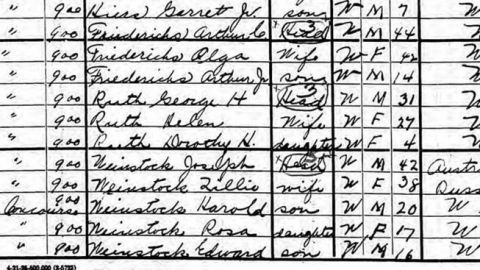
The visibility of hate groups such as the Alt-Right became mainstream into contemporary political culture during the Unite the Right Rally in Charlottesville, VA in 2017. This project aims to explore methods to quantify the presence of Latinxs within the Alt-Right, particularly in how they racialize themselves in a space...
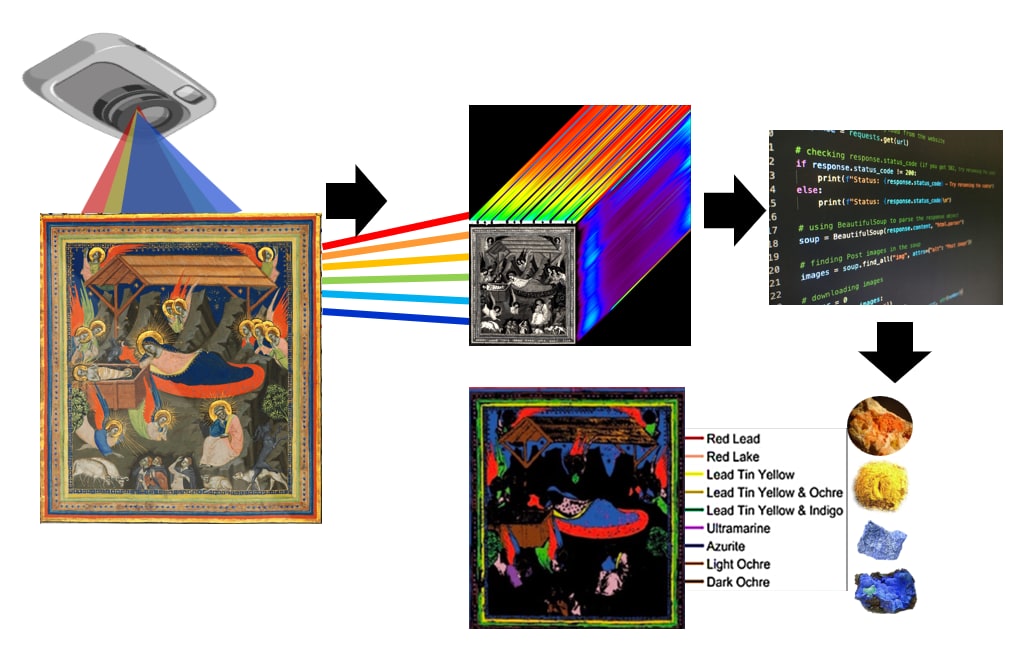
Historic artworks offer a unique window into the past, providing rich insight into history, culture, and tradition. Despite their profound significance, many works remain shrouded in mystery, raising questions about their origins, creators, and the circumstances of their production. Some of these questions can be addressed through advanced image acquisition...
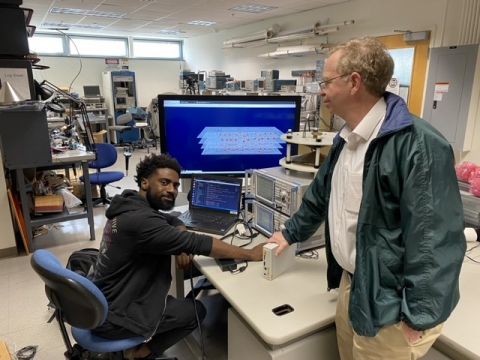
Today we design communication networks using mathematical models that describe components of the system that affect end-to-end performance. As wireless links become more highly variable, and system components become harder to model, this approach is losing ground. A team of students led by Dr. Robert Calderbank, Dr. Christ Richmond, Dr. Lingjia Liu,...

Weiyao Wang (Math) and Jennifer Du , along with NCCU Physics majors Jarrett Weathersby and Samuel Watson, spent ten weeks learning about how search engines often provide results which are not representative in terms of race and/or gender. Working closely with entrepreneur Winston Henderson, their goal was to understand how to frame this problem via statistical and machine-learning methodology,...
The 3rd City Mortality project tracks near-real-time data about individual deaths released publicly, along with metadata including data completeness and release speed, for (N=54) US state, federal, and Washington DC prison systems. Data released is often incomplete. Students will work both with mortality data already collected by the 3rd City...

Our group aims to reveal the effects of urban and agricultural land use on metabolic productivities of rivers through statistical manipulation and visualization. During this summer, we classified sites and conducted covariate analyses based on patterns of metabolism, and produced reproducible code that can be used by researchers with similar...

Exposure to local pathogens is a significant selective pressure on the human genome: the strongest selective forces identified in modern human populations are for mutations that confer increased resistance to malaria infection. Understanding how human genetic variation impacts susceptibility to pathogens can reveal important aspects of disease biology and reveal...

Vivek Sriram (Computer Science and Math), Lina Yang (Biostatistics), and Pablo Ortiz (BME) spent ten weeks working in close collaboration with the Department of Biostatistics and Bioinformatics implementing an image analysis pipeline for immunofluorescence microscopy images of developing mouse lungs. Project Results Using the LungMAP image atlas (http://lungmap.net), the team developed an image segmentation pipeline to help researchers more effectively utilize open-access images...

A team of students led by a data scientist at NetApp developed the means to evaluate technical documentation through machine learning techniques. Students identified features of language and documents that can be used to demonstrate how effective that documentation is at communicating technical specifications. Additionally, students applied machine learning methods...
Showing 201-220 of 388 results