Gerrymandering

Gerrymandering

2015

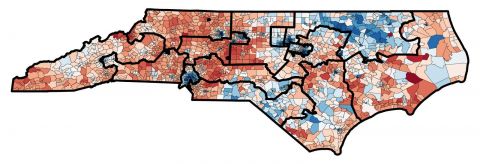
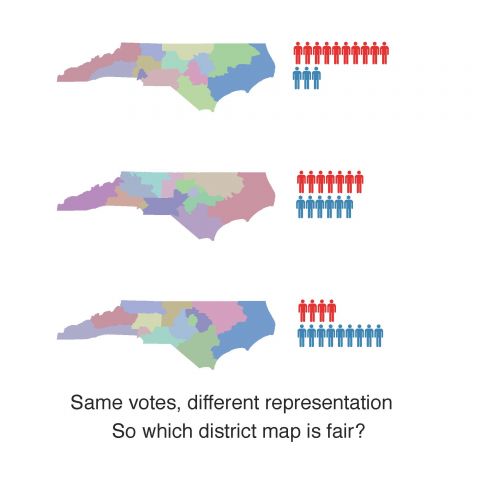
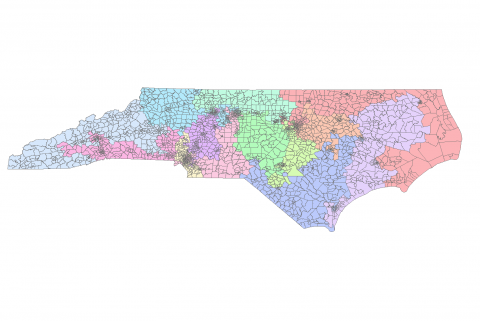
Sophie Guo, Math/PoliSci major, Bridget Dou, ECE/CompSci major, Sachet Bangia, Econ/CompSci major, and Christy Vaughn spent ten weeks studying different procedures for drawing congressional boundaries, and quantifying the effects of these procedures on the fairness of actual election results.

Project Results

There has already been research done with North Carolina districts, described in https://today.duke.edu/2014/10/mathofredistricting. There, Jonathan Mattingly and Christy Vaughn showed that randomly re-drawing district boundaries would have dramatically changed election results. This summer’s team extended the analysis to many more states, and found that states with independent election commissions (like Iowa) had statistically fairer results than states with very partisan districting systems (like Maryland).

Download the executive summary (PDF).

Gerrymandering work now posted on Arvix: https://arxiv.org/abs/1704.03360

Disciplines Involved

  • Political Science
  • Mathematics

Project Team

  • Undergraduates: Sophie Guo, Bridget Dou, and Sachet Bangia
  • Faculty Lead: Jonathan Mattingly, Professor, Mathematics
  • Graduate student mentor: Christy Vaughn, Program in Applied and Computational Mathematics, Princeton

Additional information

Relatively Prime podcast on the project.

Contact

Interim Director of the Rhodes Information Initiative at Duke University

Mathematics

Related People

Mathematics

Interim Director of the Rhodes Information Initiative at Duke University

Mathematics

Related News

Some of our Data+ projects don’t end at after summer—the students keep the work alive out of a passion for the subject they worked on. Sachet Bangia, Econ/CompSci major, along...
A three-judge federal district court panel in North Carolina again ruled in Common Cause v. Rucho that the North Carolina General Assembly violated the U.S. Constitution in 2016 when legislators manipulated congressional districts for...

This article from the Proceedings of the National Academy of Sciences on the use of math tools to show gerrymandering features the work of iiD’s Jonathan Mattingly.  

Jonathan Mattingly’s iiD projects on gerrymandering recently resulted in a published paper on the topic in Arxiv. The paper represents the most comprehensive analysis of the team’s work and was the...

Jonathan Mattingly, professor of mathematics and statistical science at Duke and iiD faculty member, and his Data+ team are mentioned in this article about gerrymandering. 

Duke Mathematics Professor Jonathan Mattingly’s algorithm demonstrating political gerrymandering in North Carolina’s district mapping was a focal point in the ruling of the 4th Circuit of Appeals judge earlier this week. The...
Duke Mathematics chair Jonathan Mattingly’s computer algorithm work on district gerrymandering in North Carolina has been referenced in a January 9, 2018 Federal Court ruling that Republicans have unfairly mapped North Carolina...

This article highlights iiD faculty member Jonathan Mattingly’s work mathematically dissecting the structure of a typical redistricting to identify gerrymandering: https://sinews.siam.org/Details-Page/detecting-gerrymandering-with-mathematics

In the first decision of its kind, federal judges threw out North Carolina’s congressional map, saying it was drawn to favor Republicans​. iiD faculty member Jonathan Mattingly testified in the case.

Duke mathematics professor and iiD faculty member Jonathan Mattingly talks about his work with mathematical modeling and gerrymandering. 

In Sanford’s Policy 360 podcast professors Jonathan Mattingly (Mathematics) and Asher Hildebrand (Public Policy) consider increasing pressures on some states to redraw district voting lines now even though they are...